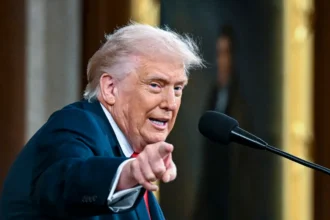

President Donald Trump used his State of the Union address this week to paint an upbeat picture of the U.S. economy, declaring the “roaring economy is roaring like never before.” New polling suggests most Americans are unconvinced.
According to a Reuters/Ipsos survey released Friday, 68 percent of Americans said they do not believe the economy is “booming.” Just 30 percent expressed confidence in current economic conditions.
Skepticism extends beyond growth claims to concerns about rising prices. The same poll found that 82 percent of respondents disagreed with the statement that “there is hardly any inflation in the U.S.” Only 16 percent agreed.
The findings align with other recent surveys measuring public sentiment toward Trump’s economic leadership. A joint poll by Washington Post, ABC News, and Ipsos released Sunday showed 57 percent of respondents disapproved of how the president is handling the economy. That survey also found 65 percent disapproval of his approach to inflation and 64 percent opposition to his tariff agenda.
Trump’s trade policies have become a focal point of economic criticism. Earlier this year, he imposed sweeping import taxes on nearly all U.S. trading partners, arguing the measures would pressure countries into negotiating trade deals more favorable to the United States.
While Trump said foreign governments would absorb the cost, a January report from the Kiel Institute for the World Economy found that American consumers and importers are paying 96 percent of the tariffs.
The financial impact on households may deepen. The nonpartisan Tax Foundation estimated this month that the tariffs will cost the average U.S. household about $1,000 in tax increases in 2025, warning that figure could rise by several hundred dollars this year if the policies remain in place.
Despite mounting pushback, Trump has defended the tariffs even after a recent ruling by the Supreme Court of the United States, which struck down most of the levies. The court cited the president’s “illegal” reliance on the “International Emergency Economic Powers Act.”
In response, Trump announced a new 10 percent tariff on imports from countries worldwide under a separate Trade Act provision. One day later, he signaled the rate could increase to 15 percent, though it remains unclear whether that escalation will take effect.
The Reuters/Ipsos poll surveyed 4,638 adults nationwide between Feb. 18 and Feb. 23 and carries a margin of error of roughly two percentage points.
Read More: Trump Approval Poll: Majority Say US on Wrong Track