
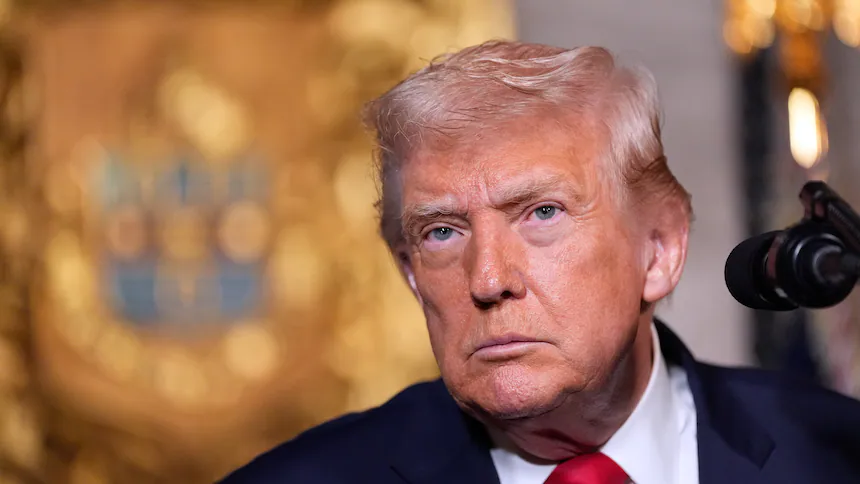
President Donald Trump said Tuesday that his decision to increase tariffs on Switzerland was influenced by a contentious phone conversation with the country’s leader, offering a candid explanation that has intensified debate over U.S. trade policy.
In an interview with Fox Business host Larry Kudlow, Trump described what he called an “emergency call” from Switzerland’s former president. According to the president, the discussion left a lasting impression.
“I didn’t really like the way she talked to us,” Trump said, recounting that the Swiss leader repeatedly emphasized, “we are a small country.” He continued: “Again and again and again. I couldn’t get her off the phone.”
Trump explained that tariffs on Swiss goods had initially stood at 30 percent. Instead of lowering them following the conversation, he said he raised them to 39 percent. “I figured, ‘Do you know what? We’ll do something that’s a little bit more palatable,’” he added, noting that he was later “inundated by people from Switzerland.”
While Trump did not mention her by name, he appeared to be referring to former Swiss President Karin Keller-Sutter, who left office Dec. 31 and was succeeded by President Guy Parmelin. The White House has not formally clarified the reference.
The president previously shared a similar account during remarks at the World Economic Forum in Davos, where he said the Swiss leader “just rubbed me the wrong way, I’ll be honest with you.”
His comments quickly drew criticism from Democrats on the House Foreign Affairs Committee, who argued the explanation undermines the administration’s long-standing justification that tariffs are rooted in national security concerns.
“In the case of Switzerland, he increased tariffs because… checks notes… he did not like the way the Swiss leader ‘talked to us,’” the committee’s Democrats wrote in a statement shared on the social platform X. “Republicans must join Democrats to end this reckless behavior.”
Despite the earlier escalation, the U.S. and Switzerland reached a trade agreement in November that reduced tariffs on Swiss imports from 39 percent to 15 percent. As part of the deal, Switzerland and Liechtenstein agreed to eliminate tariffs on several American exports, including nuts, certain fruits, seafood, chemicals and spirits, according to U.S. Trade Representative Jamieson Greer.
The controversy unfolds amid broader scrutiny of Trump’s use of emergency powers to impose import taxes on trading partners such as China, Mexico and Canada. Under the National Emergencies Act, Congress can terminate such declarations through joint resolutions — a mechanism now gaining traction.
On Tuesday, three House Republicans — Reps. Thomas Massie (R-Ky.), Kevin Kiley (R-Calif.) and Don Bacon (R-Neb.) — joined Democrats in opposing a procedural move that would have restricted lawmakers’ ability to force votes aimed at repealing tariffs. Bacon wrote on X that “Congress needs to be able to debate on tariffs.”
The vote clears the way for Rep. Gregory Meeks (D-N.Y.), chair of the House Foreign Affairs Committee, to pursue a resolution to repeal Trump’s emergency declaration tied to tariffs on Canada. A vote could occur as early as Wednesday.
Meanwhile, the Supreme Court is weighing whether a provision of the International Emergency Economic Powers Act grants the president authority to impose sweeping tariffs. During oral arguments last year, the justices appeared unlikely to divide strictly along ideological lines.
Public opinion may also shape the broader debate. A recent Marquette Law School Poll found that 63 percent of respondents want the Supreme Court to restrict “the president’s authority to impose tariffs,” while 36 percent said they prefer the court to “hold that the President has the authority to set tariffs.”