
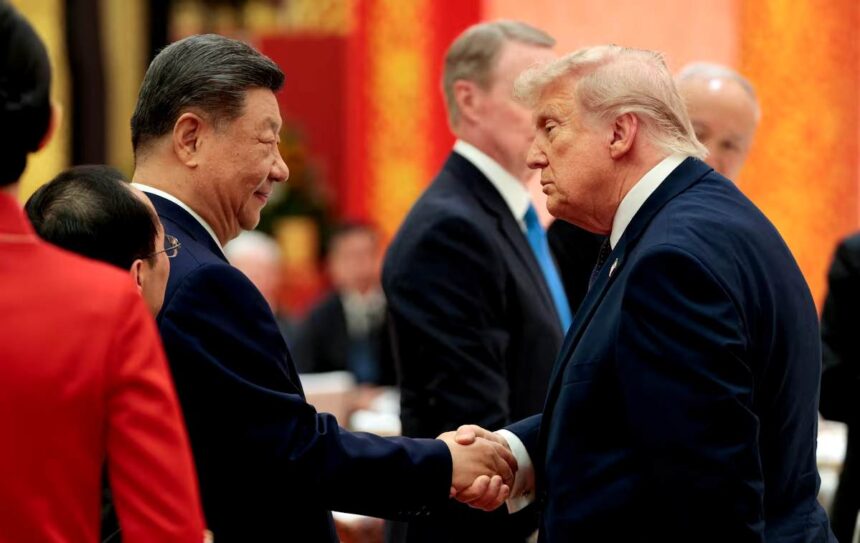
Shares of Boeing dropped more than 4% Thursday after U.S. President Donald Trump announced that China had agreed to purchase 200 Boeing aircraft — a figure investors viewed as smaller than expected.
Markets had anticipated a much larger aviation agreement tied to Trump’s meeting with Chinese President Xi Jinping. Analysts and sources familiar with the talks had previously suggested a package involving roughly 500 Boeing 737 MAX aircraft, with potential follow-up orders for widebody jets.
Instead, Trump revealed a lower number during an interview on Fox News.
“One thing he agreed to today, he’s going to order 200 jets … 200 big ones,” Trump said on Fox News’ Hannity, referring to Xi.
The announcement triggered an immediate market reaction. Boeing shares fell 4.1% during Thursday trading as investors reassessed expectations surrounding the summit and the scale of future Chinese demand.
Details surrounding the proposed purchase remain unclear. Neither side disclosed delivery schedules, aircraft models, financing arrangements, or which Chinese airlines would receive the jets. That uncertainty added pressure to Boeing stock, especially after weeks of speculation around a blockbuster order.
The aviation deal was expected to become one of the centerpieces of the Trump-Xi summit. The meeting also focused on extending a fragile trade truce reached last October. Under that arrangement, Trump paused triple-digit tariffs on Chinese imports while Beijing eased pressure on global supplies of critical rare earth materials.
China remains one of the world’s most important aircraft markets. Both Boeing and Airbus have aggressively competed for dominance there for more than a decade.
Airbus gained a stronger foothold during the 2010s and eventually overtook Boeing in Chinese market share. The European manufacturer also expanded its regional presence by opening an A320 final assembly line in Tianjin.
At the same time, Chinese airlines continue to face rising travel demand. Industry analysts estimate the country may need as many as 1,000 new aircraft in the near term. Long-term forecasts from Boeing and Airbus project China will require at least 9,000 new commercial jetliners by 2045.
China has also reportedly explored a similarly sized aircraft agreement with Airbus, increasing competitive pressure on Boeing during negotiations.
The last major Boeing-China order came during Trump’s 2017 visit to Beijing, when China agreed to purchase 300 Boeing jets. Relations between Washington and Beijing deteriorated in the years that followed, limiting Boeing’s access to the Chinese market. Since then, the company has received only 51 Chinese orders, most involving cargo aircraft rather than passenger jets.
Analysts say large aircraft purchases from China often carry political meaning beyond standard business considerations.
Airplane orders from Chinese carriers typically require approval from the central government and are frequently linked to major diplomatic visits. In many cases, the airline operating the aircraft is not identified until closer to delivery.
“It’s possible we still get more orders this trip, but right now investors are interpreting this as being less than hoped for,” said Matt Akers, an aerospace investment analyst with BNP Paribas, in comments to Reuters.
Senior American business leaders joined Trump during the China trip, including Boeing CEO Kelly Ortberg and GE Aerospace CEO Larry Culp. Executives traveled alongside the president in hopes of securing trade agreements, resolving commercial disputes, and strengthening industrial ties between the two countries.
Trump has repeatedly used trade negotiations to pressure foreign governments into increasing purchases of Boeing aircraft, viewing major aviation deals as symbols of broader economic cooperation and American manufacturing strength.