

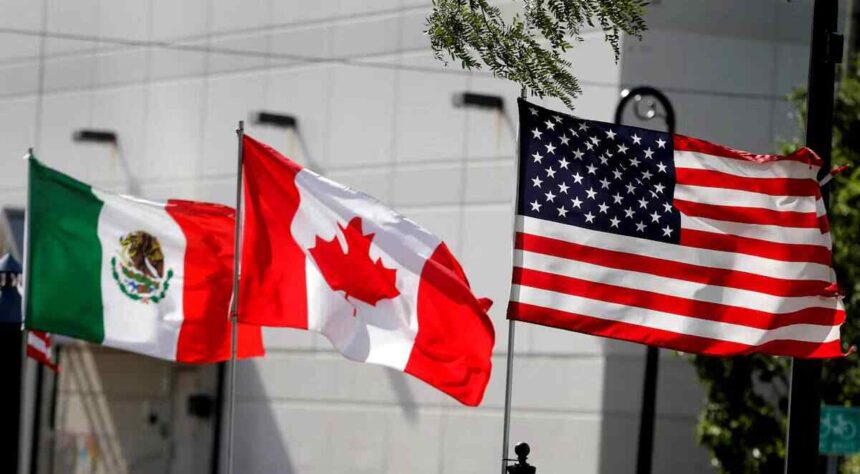
The Trump administration has decided not to renew the United States–Mexico–Canada Agreement (USMCA), setting the North American trade pact on a path toward yearly reviews instead of granting it another 16-year extension.
The announcement came Wednesday, the deadline for the three member countries to agree to renew the agreement. Although the administration declined to extend the pact, it will remain active while negotiations continue.
U.S. Trade Representative Jamieson Greer said the agreement is not ending immediately.
“The United States will continue to engage with Mexico and Canada to address the Agreement’s shortcomings and our trade deficits with these countries,” he said.
Greer also stated that the USMCA will remain “in force pending resolution of these issues or until the Agreement’s termination.”
The agreement is scheduled to expire automatically on July 1, 2036, unless the United States, Canada, and Mexico all agree to renew it for another 16 years. Without that approval before the review deadline, the pact now enters a period of annual reviews that will continue over the next decade.
Canada had pushed for an extension before the July 1 deadline. That effort did not receive support from the United States, leaving future negotiations to determine whether the agreement will eventually be renewed.
Talks with Mexico are expected to continue later this month. Greer said U.S. officials will meet with Mexican representatives during the week of July 20 for a third round of negotiations aimed at resolving outstanding trade issues.
A senior administration official said discussions with Mexico have already focused on strengthening the agreement’s rules of origin, improving economic security cooperation, and settling bilateral trade concerns.
“They [Mexico] do understand the administration’s tariff policies,” the official said, adding that Mexico had made proposals on deficit reduction.
The administration described Canada’s position as more complicated. According to the same official, Canada responded differently than most U.S. trading partners after President Donald Trump introduced new tariffs early in his second term.
“Along with the People’s Republic of China, Canada was one of the only countries in the world to retaliate against the United States following the president’s historic trade action to eliminate the U.S. trade deficit and reshore manufacturing,” the official said, but noting the administration would continue discussions with Canada.
The Trump administration has argued that changes to the agreement are needed to reduce trade imbalances with both neighboring countries. According to Reuters, the United States recorded a $46 billion goods trade deficit with Canada and a $197 billion goods trade deficit with Mexico last year.
Trump imposed tariffs on Canada and Mexico at the start of his second term as part of a broader effort to reshape U.S. trade policy and encourage more domestic manufacturing.
Earlier this month, Trump signaled that he did not intend to extend the current agreement.
“I made the deal and the primary reason I made the deal is that NAFTA was the worst trade deal I’ve ever seen. Yeah. And I made it better. But I had the right to terminate,” the president said at the time, referencing the previous agreement called the North American Free Trade Agreement.
The administration has indicated that negotiations with both Canada and Mexico will continue even as the USMCA enters its annual review process, leaving the future of North America’s trade framework dependent on the outcome of those talks.