
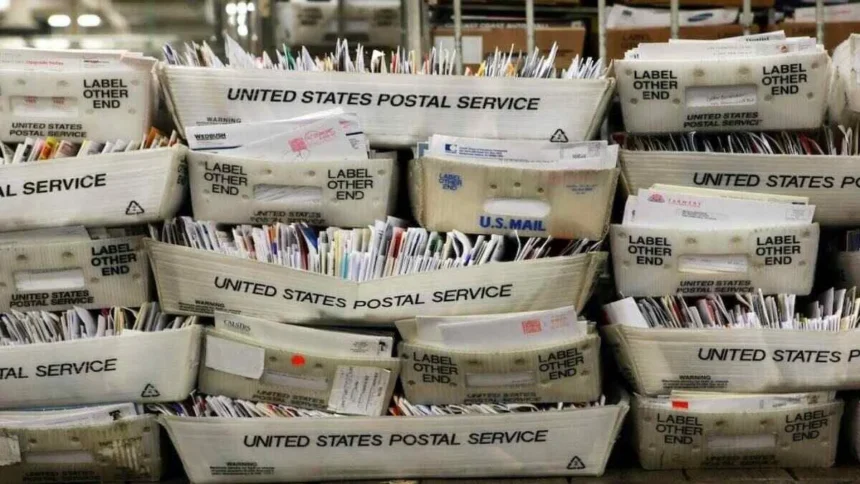
A federal judge on Friday issued a preliminary injunction halting the U.S. Postal Service from carrying out President Donald Trump’s executive order to restrict mail-in voting for the upcoming midterm elections.
The ruling by U.S. District Court Judge Indira Talwani replaces a temporary freeze she previously put on the administration’s postal plan. The decision places a fresh legal barrier in front of the White House just as state election officials start delivering mail ballots to voters.
In her decision, Talwani pointed out the severe time constraints facing local election administrators across the country.
“Plaintiff States are required under state law to mail millions of ballots to voters on a prescribed timeframe. As detailed below, they are unable to pivot this late in the election cycle, nearly guaranteeing significant disenfranchisement for eligible voters,” she wrote.
The White House did not respond immediately to a request for comment.
Under the current court ruling, states retain the option to voluntarily adopt the Postal Service’s proposed system. However, no state has opted to implement it.
The legal fight stems from an executive order signed by Trump in March. That directive spurred multiple lawsuits from voting rights advocates and Democratic organizations. Talwani initially paused the order in June, but the U.S. Supreme Court later overturned that hold on procedural grounds.
The conservative majority on the high court did not rule on the legality of the president’s action. Instead, the justices determined the legal challenges were submitted too early, before the Postal Service had formally issued its implementation rules. Plaintiffs immediately refiled their claims once those regulations were released.
Trump has repeatedly targeted mail-in balloting, frequently linking it to unfounded allegations regarding his defeat in the 2020 presidential election. Despite those claims, he often casts his own vote by mail.
An earlier executive order from last year aimed at changing federal election rules—including a requirement for voters to provide documentary proof of citizenship—was previously struck down by federal courts. Judges in those cases determined that the U.S. Constitution grants state governments and Congress the authority to regulate voting procedures, rather than the executive branch.