

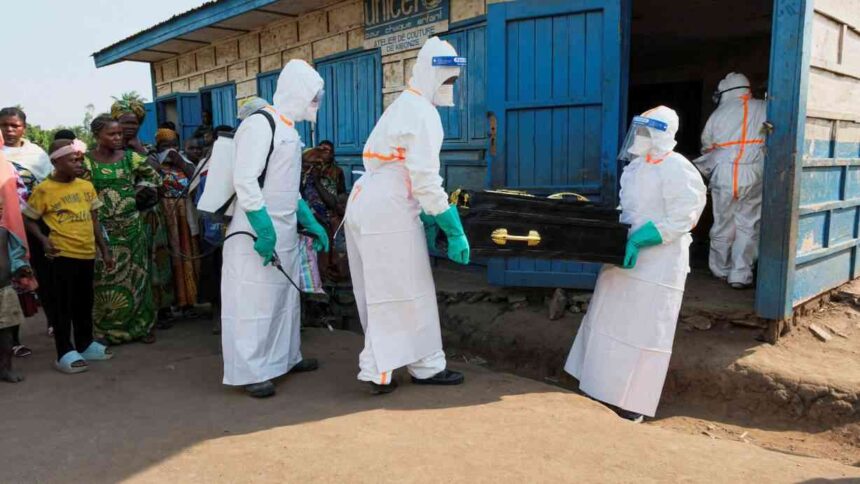

BUNIA, DEMOCRATIC REPUBLIC OF THE CONGO — The ongoing Ebola outbreak in the Democratic Republic of the Congo (DRC) has crossed a grim milestone, officially exceeding 2,000 confirmed cases and claiming 754 lives. Government data released overnight confirms that the epidemic is now the fastest-growing Ebola outbreak on record.
The health crisis deepened significantly on Wednesday when medical staff at Bunia General Hospital, the largest medical center in the regional epicenter, walked off the job. Striking doctors, nurses, and frontline personnel barricaded the facility’s main entrance. The workers state they have received no salary or hazard compensation since the crisis was declared on May 15, despite operating under perilous and exhausted conditions.
The international medical charity Medecins Sans Frontieres (MSF) warned that the deadly virus is moving much faster than containment mechanisms. Cases have tripled in less than five weeks. Global health agencies confirm the crisis is now in a severe expansion phase, aggravated by intense population displacement and delayed medical intervention.
“Every delay costs lives,” stated Trish Newport, MSF’s emergency programme manager. “We are still chasing the outbreak instead of staying ahead of it.”
Compounding the emergency, the World Health Organization (WHO) revealed that more than 100 healthcare workers have already been infected. Furthermore, health officials admit that 80% of new infections are emerging from completely unknown transmission chains. This indicates the virus is spreading silently and undetected through local communities.
Unlike the more common Zaire strain responsible for most of the DRC’s past outbreaks, this epidemic is fueled by the rare Bundibugyo virus species. There are currently no globally approved vaccines or targeted antiviral treatments available for this specific strain.
Related: US Bombs Iranian Island as Tehran Threatens to Block Global Energy Routes
The disease spreads through direct contact with the bodily fluids of infected individuals or wild animals. It triggers severe symptoms, including explosive vomiting, high fevers, and catastrophic internal and external bleeding. Regional containment is heavily restricted by a massive funding shortfall, local mistrust, and armed conflict across eastern Congo.
In a bid to halt the regional crisis, scientists at the University of Oxford have rapidly launched a Phase I human clinical trial for a tailored vaccine. The vaccine was engineered in just eight weeks using the same viral vector technology utilized in the Oxford/AstraZeneca COVID-19 vaccine.
The early-stage trial is currently recruiting 50 healthy adult volunteers in the United Kingdom to evaluate safety and immune responses. If successful, the Coalition for Epidemic Preparedness Innovations (CEPI) will collaborate with the Serum Institute of India—which has already stockpiled 620,000 doses—to fast-track trials and emergency deployment within Africa.