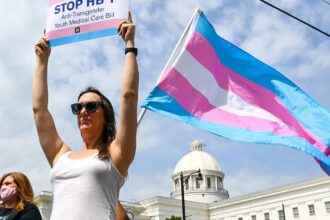

A group of transgender Idaho residents has taken legal action against the state, challenging a new law that could criminalize their use of public restrooms. The lawsuit, filed Thursday in federal court, targets House Bill 752, which imposes misdemeanor and felony penalties on individuals who use facilities not aligned with their sex assigned at birth.
The case centers on six plaintiffs—Diego Fable, Amelia Milette, Emilie Jackson-Edney, Daniel Doe, Peter Poe, and Zoey Wagner, who argue the law threatens their safety and daily lives. Their legal team includes attorneys from the American Civil Liberties Union, its Idaho affiliate, and Lambda Legal, along with private law firms.
Gov. Brad Little approved the measure earlier this month after it passed through the Republican-controlled legislature. The law is scheduled to take effect on July 1 and applies broadly, covering both government buildings and private businesses open to the public. That includes locations such as hospitals, airports, libraries, and shopping centers.
Under the statute, a first violation is classified as a misdemeanor, carrying up to one year in jail. A second offense escalates to a felony, with potential prison time of up to five years. Legal analysts note that Idaho’s law is the only one in the country that extends to private businesses in this way.
Plaintiffs argue the rule forces an impossible choice: risk arrest or avoid public life altogether. Fable, one of the individuals named in the suit, described the emotional impact when the proposal first surfaced.
“I felt a heavy lump grow in my chest.”
He later explained how the law affects routine decisions. “Do I comply and use the women’s restroom and risk drama?” he said. “Do I drive all the way home [to a toilet] and then come back?”
Fable, who transitioned six years ago, said his daily life had been stable until now. “been enjoying life as a man and using the men’s restrooms hasn’t been a big deal.”
He warned the new requirement would expose him to scrutiny. “But this law would force me to use the women’s facilities, and doing so would only invite suspicion, questions, and raised eyebrows.”
According to court filings, the plaintiffs seek to block enforcement before it begins. Their attorneys argue the law creates “life-changing criminal penalties or physical and psychological harm for simply using the restroom.”
Law enforcement organizations have also raised concerns. The Idaho Fraternal Order of Police and the Idaho Chiefs of Police Association opposed the legislation, stating there is no “clear or reasonable way” to confirm a person’s sex assigned at birth during routine interactions without resorting to “invasive and inappropriate” methods.
Supporters of the bill defend it as a safety measure. State Rep. Cornel Rasor, who sponsored the legislation, told lawmakers it aims to protect women and girls in shared spaces.
“It prevents discomfort and voyeurism escalation and assaults, while preserving single-user options and narrow exceptions so no one is denied access for emergency aid,” he said.
The federal court will now weigh whether the law violates constitutional protections, setting up a legal battle that could influence similar policies nationwide.