
New Jersey has enacted sweeping changes to how state authorities interact with federal immigration enforcement, escalating tensions between state leadership and the Trump administration over immigration policy and public safety.
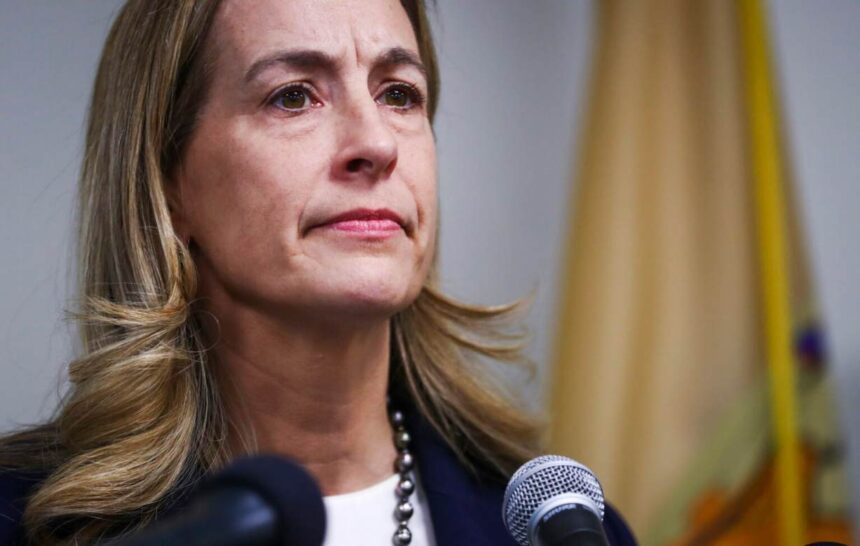
Governor Mikie Sherrill signed a package of laws on Wednesday aimed at curbing the role of U.S. Immigration and Customs Enforcement (ICE) within the state. The legislation introduces new limits on cooperation with federal immigration authorities, while also imposing restrictions on how ICE agents operate locally.
At the center of the policy shift is a controversial ban preventing ICE officers from wearing face masks during enforcement operations in New Jersey. The new laws also block state officials from sharing residents’ immigration status with federal agencies and reduce coordination between local law enforcement and federal immigration authorities.
Framing the move as a public safety measure, Sherrill sharply criticized federal enforcement tactics under Donald Trump.
“Donald Trump’s untrained, unaccountable, masked ICE agents are putting people in danger,” Sherrill wrote on the social platform X on Wednesday afternoon.
“That’s why I just signed a package of legislation to keep our communities safe – strengthening trust between law enforcement and the communities they serve, banning ICE agents from wearing masks, and protecting residents’ privacy from federal overreach,” the governor continued. “In New Jersey, we still follow the Constitution and uphold the rule of law.”
Federal officials swiftly condemned the measures, warning they could jeopardize officer safety and conflict with constitutional authority. U.S. Department of Homeland Security (DHS) officials argued the state lacks the power to regulate federal enforcement practices.
Lauren Bis, a senior DHS official, described the mask ban as a direct threat to agents.
“To be crystal clear: we will not abide by this unconstitutional ban,” Bis wrote. “The Supremacy Clause makes it clear that New Jersey’s sanctuary politicians do not control federal law enforcement.”
The Supremacy Clause establishes that federal law overrides conflicting state laws, a principle now central to the escalating dispute.
DHS has maintained that face coverings are necessary to protect agents and their families from retaliation, including doxing and harassment.
“This law from sanctuary politicians in New Jersey is irresponsible, reckless, and dangerous,” Bis said. “ICE officers wear face coverings for one reason: to protect themselves and their families from real-world threats including agitators.”
The legislation marks the latest development in an ongoing clash between New Jersey and federal authorities over immigration enforcement. Earlier this year, the Trump administration filed legal action against Sherrill following an executive order restricting federal arrests on certain state-controlled properties, including courthouses.
Sherrill has also taken legal steps to block the construction of a new immigration detention facility in the state, citing concerns over oversight and community impact.
The policy shift in New Jersey mirrors a growing trend among Democratic-led states. Washington Governor Bob Ferguson recently approved a similar mask restriction, while Virginia Governor Abigail Spanberger signed legislation ending her state’s cooperation agreements with ICE earlier this year.
Meanwhile, the broader national debate continues to intensify. Congressional Democrats have withheld funding from DHS for over 40 days, pushing for reforms that include a federal mask ban, stricter oversight measures, and updated warrant requirements for immigration enforcement operations.
As legal challenges loom, New Jersey’s new immigration laws are likely to become a major test of state versus federal authority in shaping U.S. immigration enforcement policy.
Read More:
- DOJ throws ICE under the bus for ‘attorney error’ that exposed falsity of ‘core’ defense
- Judge Asked to Block Trump Name on Kennedy Center