
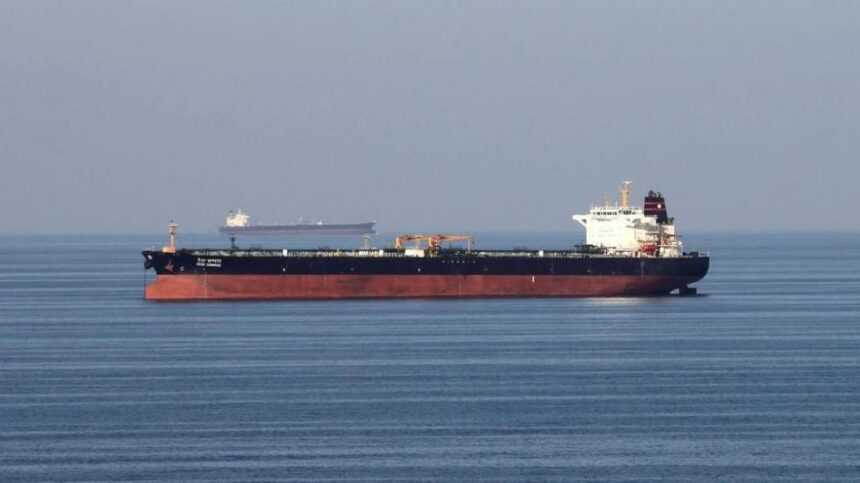
Oil prices surged past $100 a barrel on Monday after US President Donald Trump ordered a naval blockade targeting Iranian ports, escalating tensions following failed peace talks with Tehran.
Brent crude briefly climbed to $102.02 before retreating to around $98 in US trading hours. The rebound erased last week’s sharp drop, when prices fell below $100 after a temporary ceasefire raised hopes of stability in the region.
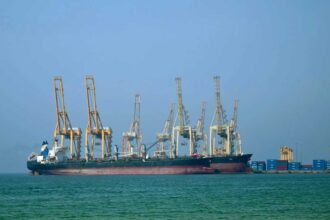
The breakdown in negotiations has reignited fears of a prolonged global energy crisis, centered on the Strait of Hormuz, a narrow but vital shipping lane responsible for roughly 20% of global oil and gas flows.
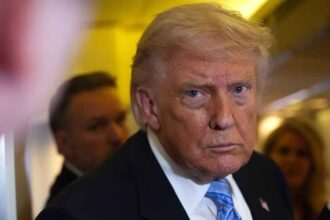
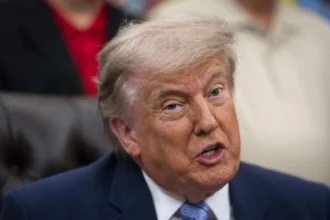
The situation worsened after Trump declared that “effective immediately”, the US Navy “will begin the process of BLOCKADING any and all Ships trying to enter, or leave, the Strait of Hormuz”.
US Central Command clarified that the blockade would focus on vessels linked to Iranian ports, starting Monday morning, while allowing transit to non-Iranian destinations.
Iran quickly pushed back. Its military described the move as “illegal and constitutes piracy”, warning it would enforce a “permanent mechanism to control the Strait of Hormuz following US threats”.
The waterway has already become a flashpoint. Iran had earlier threatened to target ships passing through the strait in response to US-Israeli strikes, disrupting maritime traffic and driving up global fuel costs.
Despite the standoff, Iranian oil exports have not stopped. Maritime intelligence firm Windward reported that over 58 million barrels have left Kharg Island since early March, with more than 90% heading to China.
Beijing has urged restraint, stressing the global importance of the route. A foreign ministry spokesperson said: “The Strait of Hormuz is an important international trade route for goods and energy, and maintaining its security, stability and unimpeded flow is in the common interest of the international community.”
Economists say the blockade may carry strategic intent beyond immediate pressure on Iran. Neil Shearing of Capital Economics suggested it could be “designed to pressure Beijing into playing a more active role in mediating a ceasefire and reopening full trade flows through the Strait”.
Market analysts remain cautious. Chua Yeow Hwee from Nanyang Technological University said: “Oil prices are likely to remain elevated because expectations now depend on whether the blockade is fully implemented, whether shipping disruptions spread, and whether diplomacy resumes.”
Others note that prices could climb even higher. Saul Kavonic of MST Marquee said “oil prices are not as high as they normally would be” given the scale of disruption, adding that further increases are likely if shipments do not resume.
The economic stakes extend far beyond oil. Former US envoy David Satterfield highlighted the broader supply chain risks: “It is about 30% of the world’s aluminium, it is 30% of the world’s helium, it is up to 50% of the feed stocks for fertilizers around the world and it is about 17% of all polymers.”
“The impact, if this goes on for several more weeks, is going to become quite profound beyond the cost of petrol and diesel at the pump.”
Attention is now shifting to whether the fragile ceasefire will hold. Marcus Baker of Marsh warned that market confidence depends heavily on Iran’s next move, asking: “Will the Iranians decide that actually, despite what the US has said, they will continue to honour the ceasefire?”
Financial markets reflected the uncertainty.
European stocks trimmed earlier losses but remained in negative territory by midday. The FTSE 100 slipped 0.35%, France’s CAC fell 0.8%, and Germany’s DAX dropped 1%.
Asian markets also declined, with Japan’s Nikkei 225 down 0.7% and South Korea’s Kospi falling 0.9%, highlighting the region’s heavy reliance on Middle Eastern oil.
In the United States, markets opened lower but later recovered. The Dow Jones rose 0.2%, while the Nasdaq gained 0.8% and the S&P 500 climbed 0.6%.
For now, traders are watching the Strait of Hormuz closely. The next move, military or diplomatic could determine whether oil prices stabilize or surge further.