

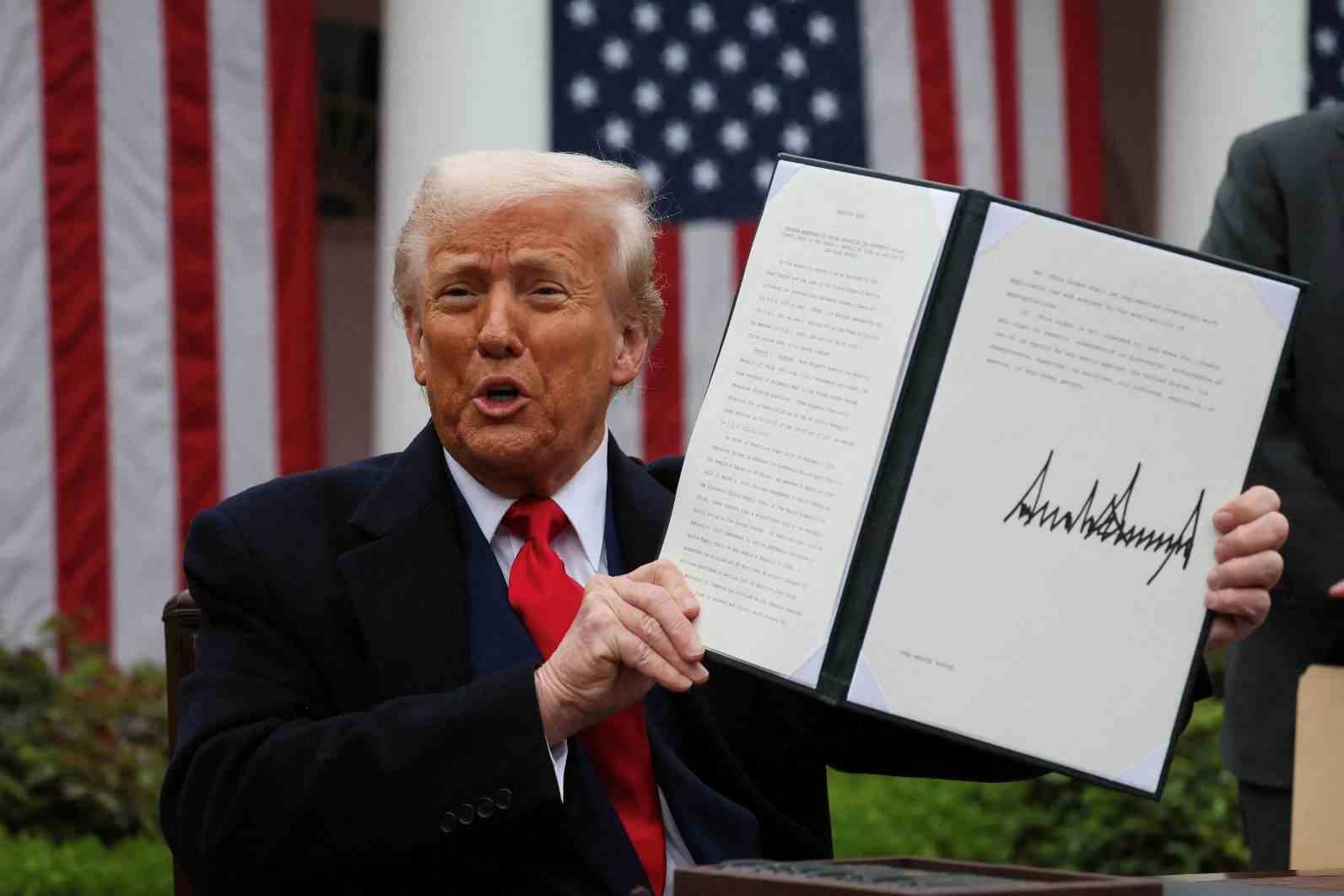

In a decision with sweeping economic implications, the Supreme Court on Friday struck down the core of President Donald Trump’s tariff framework, ruling that the emergency powers law used to justify the measures does not authorize the imposition of broad import taxes. The judgment dismantles a central pillar of the administration’s trade strategy and sets the stage for new legal and financial disputes.
At the heart of the ruling is the International Emergency Economic Powers Act (IEEPA), a statute enacted in the 1970s that grants presidents authority to regulate certain economic transactions during national emergencies. The justices concluded that the law’s language does not extend to tariffs, rejecting the administration’s interpretation that import duties fall within the scope of “regulating” imports.
“We claim no special competence in matters of economics or foreign affairs,” Chief Justice John Roberts wrote. “We claim only, as we must, the limited role assigned to us by Article III of the Constitution. Fulfilling that role, we hold that IEEPA does not authorize the President to impose tariffs.”
The ruling marks a historic boundary for executive power. Trump is the first U.S. president to invoke IEEPA to implement tariffs in the law’s nearly five-decade history. The decision invalidates duties applied across a wide range of countries under emergency declarations tied to issues including fentanyl trafficking and trade deficits.
While the court’s opinion resolves the legality of the tariffs themselves, it leaves unresolved how businesses might recover funds already paid. As of January 2026, the U.S. government had collected approximately $289 billion in tariff-related revenue, according to data from the Bipartisan Policy Center. Any refund mechanisms are expected to be contested in lower courts.
The financial consequences could be significant for both companies and federal accounts. Legal experts anticipate a wave of claims from importers seeking reimbursement for duties now deemed unlawful. Major corporations — including Costco, segments of the Toyota Group, and Revlon — had previously initiated legal action to preserve their rights, though none were direct parties to the Supreme Court case.
Instead, the litigation centered on challenges brought by Democratic-led states and coalitions of small businesses. Those plaintiffs argued that the administration’s expansive reading of IEEPA exceeded constitutional and statutory limits, a position ultimately endorsed by the majority of the court.
Not all justices agreed. Justice Brett Kavanaugh, joined by Justices Clarence Thomas and Samuel Alito, dissented, arguing that tariffs are historically recognized tools for regulating imports and should fall within presidential emergency powers.
“The sole legal question here is whether, under IEEPA, tariffs are a means to ‘regulate … importation,’” Kavanaugh wrote. “Statutory text, history, and precedent demonstrate that the answer is clearly yes: Like quotas and embargoes, tariffs are a traditional and common tool to regulate importation.”
Kavanaugh suggested the administration’s policy objectives may survive under different legal authorities, writing that the dispute amounted to reliance on the “wrong statutory box.” His dissent indicates that alternative pathways for trade restrictions may remain open.
Importantly, the decision does not affect sector-specific tariffs enacted under separate statutes. Duties targeting industries such as steel, aluminum, and copper remain intact, as they were not part of the case before the court.
For the Trump administration, the outcome represents a rare judicial setback after a series of favorable emergency rulings in other disputes. It is also the first definitive Supreme Court opinion addressing the underlying legality of one of Trump’s major economic policies rather than procedural questions.
Despite the defeat, policy options remain. Congress retains constitutional authority over tariffs, and the administration could seek new trade measures through legislation or by invoking other existing trade laws.
Reaction from the plaintiffs was swift. Ilya Somin, an attorney representing several businesses challenging the tariffs, described the ruling as a landmark affirmation of constitutional limits.
“Today, the Supreme Court rightly ruled that the International Emergency Economic Powers Act does not give the President the power to ‘impose tariffs on imports from any country, of any product, at any rate, for any amount of time,’” Somin said. “It’s a major victory for the constitutional separation of powers, for free trade, and for the millions of American consumers and businesses enduring the higher taxes and higher prices as a result of these tariffs.”
The broader economic and political effects of the ruling are expected to unfold over months, as courts, regulators, and businesses navigate the practical consequences of a decision that reshapes the boundaries of presidential authority in global trade.