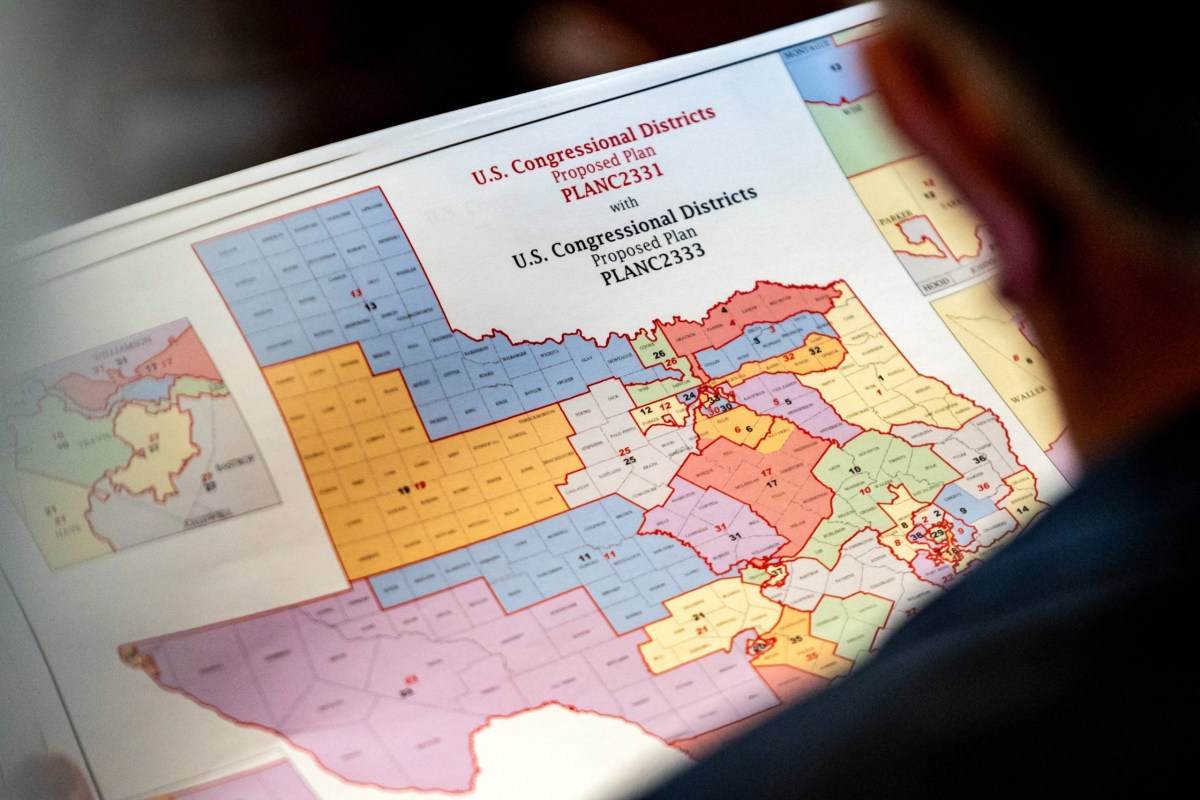

A federal judicial panel has halted Texas’ attempt to implement a new congressional map for the 2026 cycle, ruling that state lawmakers relied on unconstitutional racial gerrymandering when they redrew the lines at the urging of President Donald Trump. The decision forces Texas to revert to the congressional boundaries approved in 2021, throwing a wrench into Republican plans to expand their dominance across the state’s 38 House districts.
In a sharply worded ruling, U.S. Judge Jeffrey Brown wrote that “substantial evidence shows that Texas racially gerrymandered the 2025 Map,” rejecting the state’s argument that the redistricting effort was driven solely by partisan goals. Brown ordered the 2026 elections to proceed under the previous boundaries, leaving candidates just weeks to reassess their campaigns before the Dec. 8 filing deadline.
The map, signed by Gov. Greg Abbott in August, was crafted to boost GOP control from 25 to 30 districts and strengthen the party’s razor-thin majority in the U.S. House. But the court found that the process was shaped heavily by pressure to create new majority-Hispanic districts at the expense of existing coalition districts—an effort advocacy groups said was intended to dilute the political power of Black and Hispanic voters.
“A federal court just stopped one of the most brazen attempts to steal our democracy that Texas has ever seen,” said Texas House Minority Leader Gene Wu. “Greg Abbott and his Republican cronies tried to silence Texans’ voices to placate Donald Trump, but now have delivered him absolutely nothing.”
The ruling, issued by Brown, Judge David Guaderrama, and Judge Jerry Smith, instantly reshaped the political landscape. Democrats who had been drawn into primary battles or pushed toward forced retirements are now free to remain in their existing districts. Republican hopefuls who had lined up to run in newly tailored districts must now rely on a potential Supreme Court intervention—a narrow window given the election calendar.
The decision reversed months of campaign maneuvering. Austin-area Democrats Greg Casar and Lloyd Doggett, who had positioned themselves for a merged district, adjusted plans within hours of the ruling. Casar said he would return to run in Texas’ 35th Congressional District “provided the decision stands,” opening the door for Doggett to continue representing the 37th District.
“The Trump Abbott maps are clearly illegal, and I’m glad these judges have blocked them,” Casar said.
The impacts extend to Houston as well, where a competitive primary in Texas’ 18th Congressional District had emerged following the death of Rep. Sylvester Turner. With the new lines sidelined, Rep. Al Green is likely to remain in his current seat, avoiding an intra-party showdown.
The ruling marks only the beginning of a prolonged legal battle. A broader lawsuit challenging Texas’ entire 2021 redistricting cycle is still pending before the same three-judge panel, which signaled it may wait for forthcoming Supreme Court guidance on major voting-rights issues.
For Republicans, the setback derails a strategy openly described as essential to preserving House control. During debate on the map, Sen. Phil King warned that failure to redraw the districts posed “an extreme risk that [the] Republican majority will be lost,” predicting political “inquisitions and impeachments” if Democrats gained ground.
Texas officials argued the redistricting process was purely partisan, a type of rationale previous Supreme Court decisions have shielded from federal court intervention. But plaintiffs emphasized a letter from the U.S. Department of Justice pressing the state to address four majority non-white districts, saying it became the driving force behind the entire redraw.
Brown criticized the DOJ letter as containing “so many factual, legal and typographical errors,” but noted the state repeatedly cited it as justification. “The Governor explicitly directed the Legislature to draw a new U.S. House map to resolve DOJ’s concerns,” Brown wrote. “In press appearances, the Governor plainly and expressly disavowed any partisan objective and instead repeatedly stated that his goal was to eliminate coalition districts and create new majority-Hispanic districts.”