

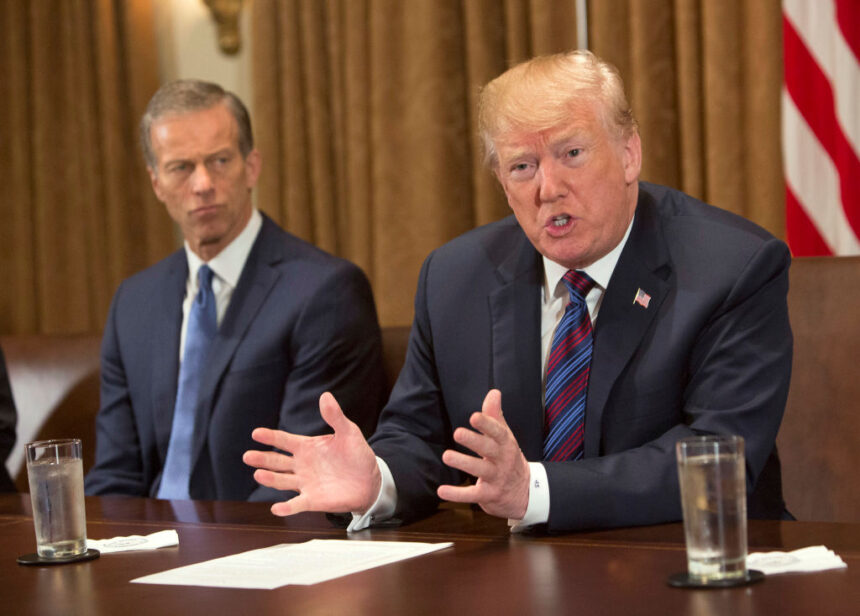
President Donald Trump renewed his pressure campaign against the Senate’s top procedural adviser on Monday, demanding that Senate Majority Leader John Thune remove Senate Parliamentarian Elizabeth MacDonough after a ruling that blocked Republicans from advancing the SAVE America Act through a fast-track legislative process.
The dispute centers on Republican efforts to pass election-related measures requiring proof of citizenship for voter registration and photo identification to cast ballots. Trump argues that MacDonough’s rulings have become a major obstacle to key GOP priorities.
“Senate Majority Leader John Thune should immediately fire the parliamentarian, who treats Republicans and everything they stand for horribly!” Trump posted on Truth Social.
The latest clash emerged after MacDonough determined that the SAVE America Act did not meet the requirements of the Senate’s Byrd Rule. That rule governs what policies can be included in budget reconciliation bills, which can pass the Senate with a simple majority instead of the 60 votes normally needed to overcome a filibuster.
Because of that ruling, Republican Sens. Lindsey Graham of South Carolina and Mike Lee of Utah were forced to seek support from 60 senators to waive budget restrictions and add the proposal to the reconciliation package.
Their efforts failed.
When Graham first attempted to suspend the budget rules, four Republicans broke ranks and voted against the move: Susan Collins of Maine, Mitch McConnell of Kentucky, Lisa Murkowski of Alaska, and Thom Tillis of North Carolina.
Trump pointed to the parliamentarian’s decision as evidence that Senate Republicans should replace her.
“Just the other night, as an example, she ruled against us on a proposal that would have easily been approved, and should have been, by anyone else,” Trump posted.
“We have every right to change her, and should do so, IMMEDIATELY. As long as she’s there, we will never get our desperately needed SAVE AMERICA ACT, approved, and put into full force and effect!” Trump wrote.
The president’s criticism is not new. He has repeatedly targeted MacDonough in recent months, particularly after she ruled against provisions Republicans hoped to include in a broader budget package.
One ruling that drew Trump’s attention involved a proposal allocating $1 billion for White House security upgrades, including funding for a planned 90,000-square-foot ballroom. MacDonough determined that provision could not move forward under reconciliation rules.
Last month, Trump also tied MacDonough to broader Republican frustrations over legislative setbacks.
“The Dumocrats cheat, lie, and steal, especially when it comes to Votes in Elections, but stick together, whereas the Republicans allow the Elizabeth MacDonoughs of the World to stay in power, and brutalize us. We need THE SAVE AMERICA ACT passed, and NOW,” Trump wrote last month.
Despite Trump’s demands, Thune has consistently resisted calls to remove the parliamentarian. The South Dakota Republican has warned that doing so could create significant political and procedural problems within the Senate, where longstanding rules give the minority party greater influence than in the House of Representatives.
“That’s, I guess, his opinion. But that would create even more vote issues here if we were to try and do something like that,” Thune said when asked previously about Trump’s request.
On Monday, Trump also criticized the origins of MacDonough’s appointment. She was elevated to the parliamentarian position in 2012 during the Senate Democratic majority led by Harry Reid while Barack Obama was president. Trump additionally faulted former Senate Majority Leader Mitch McConnell for retaining her after Republicans regained control of the chamber following the 2014 elections.
“She was put there by then Senate Majority Leader Harry Reid, and Barack Hussein Obama, need I say more? She is a nasty holdover from Mitch McConnell (A man who has proven to be very disloyal to John Thune!)” Trump posted on Monday.
The standoff highlights a growing divide between Trump’s push for aggressive procedural changes and Senate Republicans who remain cautious about altering institutional rules that could reshape how the chamber operates in the future.