
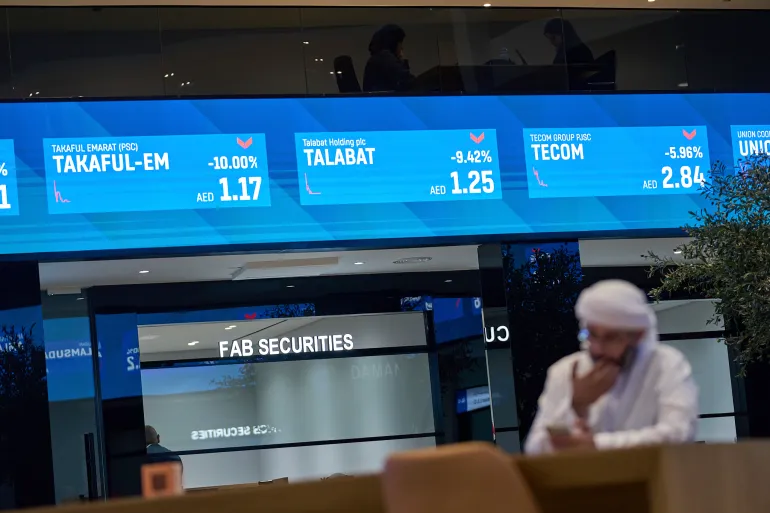
The United Arab Emirates’ financial markets have suffered a sharp downturn, wiping out an estimated $120 billion in value as the ongoing conflict involving Iran continues to shake global investor confidence.
Since the United States and Israel launched military operations on February 28, benchmark indexes in both Dubai and Abu Dhabi have recorded significant losses, positioning them among the worst-hit markets globally during the crisis.
Dubai’s main index has dropped roughly 16 percent, while Abu Dhabi’s benchmark has declined about 9 percent. In monetary terms, the Dubai Financial Market has lost approximately $45 billion in market capitalization, while the Abu Dhabi Securities Exchange has shed nearly $75 billion.
The downturn reflects a broader regional reaction, though with varying intensity. Stock markets in Qatar and Bahrain have fallen by about 4 percent and 7 percent respectively, while Saudi Arabia and Oman have managed to post gains during the same period. Meanwhile, in the United States, the S&P 500 has declined around 7 percent, influenced in part by uncertainty surrounding statements from Donald Trump regarding the trajectory of the conflict.
Despite the UAE’s relatively lower exposure to energy supply disruptions—particularly compared to other Gulf nations affected by tensions around the Strait of Hormuz—the country’s economy has not been immune to fallout. Aviation and tourism, key pillars of the UAE economy, have taken a noticeable hit.
Air travel has been severely disrupted, with tens of thousands of flights canceled since the conflict began. Many of these cancellations involve routes connected to Dubai’s international airport, widely regarded as the busiest hub for international passengers.
The economic stakes are substantial. Tourism and travel contributed roughly $70 billion to the UAE economy last year, accounting for about 13 percent of the country’s GDP. Any prolonged disruption could therefore have ripple effects across multiple sectors.
Market analysts, however, suggest that the current downturn may not signal long-term structural weakness. Haytham Aoun, an assistant professor of finance at the American University in Dubai, characterized the losses as a short-term reaction rather than a deeper economic threat.
“It is clearly a short-term setback to investor sentiment and market confidence, but not necessarily a fundamental challenge to the UAE’s long-term economic plan,” Aoun told Al Jazeera.
He emphasized that global financial hubs are evaluated on more than market fluctuations during crises, adding: “International financial centres are judged not only by market performance during crises but also by the quality of regulation, liquidity management, institutional resilience, and operational continuity.”
The UAE has spent years strengthening its financial services sector as part of a broader diversification strategy aimed at reducing dependence on oil revenues. This effort has elevated the country’s standing in regional capital markets, with the total value of listed companies surpassing $1 trillion in 2024—second only to Saudi Arabia in the Middle East.
Dubai’s ambitions extend even further. The emirate recently achieved its highest-ever ranking—seventh place—in the Global Financial Centres Index, underscoring its growing competitiveness on the world stage. Under a long-term economic roadmap launched in 2023, UAE leaders aim to position Dubai among the top four global financial centers by 2033.
Experts remain optimistic about a rebound once geopolitical tensions ease. Burdin Hickok, a professor at New York University School of Professional Studies, believes the current volatility is unlikely to alter the fundamental appeal of UAE markets.
“From a long-term perspective, I don’t see this volatility as exceptional,” Hickok told Al Jazeera.
“The fundamental attractiveness of both stock markets is not changing, meaning regulatory or capital restrictions, which would be a more fundamental change,” he added.