
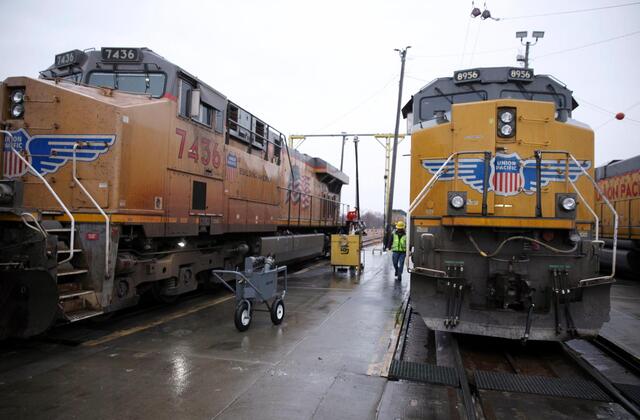
Union Pacific has renewed its push for an $85 billion merger with Norfolk Southern, filing a revised proposal aimed at winning over federal regulators who previously rejected the deal.
The new application, submitted Thursday to the Surface Transportation Board, attempts to address concerns about market competition and service disruptions. Regulators had asked for more clarity on how the merger would affect the balance among the nation’s largest freight rail companies and the customers that rely on them.
Union Pacific CEO Jim Vena argues the updated proposal strengthens the case for consolidation. He says combining the two rail networks could cut delivery times by one to two days by removing the need to transfer shipments between rail systems in the central United States. The company also estimates the shift could move about 2.1 million truckloads off highways each year, easing congestion and lowering emissions.
The deal, if approved, would reshape the U.S. freight rail landscape. Today, Union Pacific and BNSF Railway dominate the western half of the country, while Norfolk Southern and CSX control much of the eastern region. Canadian operators also compete along cross-border routes.
A merged Union Pacific–Norfolk Southern system would control close to 40% of U.S. freight traffic. Company executives argue that share would not drastically alter competition, noting that BNSF already handles a similar portion of shipments. Critics disagree.
Opposition intensified this week as BNSF and Canadian Pacific Kansas City formed a coalition with shipper groups and labor organizations. They warn the merger could reduce options for customers and drive up transportation costs.
“This did not begin with a customer asking for a UP-NS merger to happen,” BNSF CEO Katie Farmer said. “It’s driven by Wall Street on the promise of a big shareholder payout. It will eliminate competition, raise costs for consumers, and destabilize the supply chain that powers the American economy.”
Regulators are especially cautious about large rail mergers. Past deals in the late 1990s and early 2000s caused severe service disruptions as companies struggled to integrate operations. That history led the Surface Transportation Board to adopt stricter standards, requiring proof that any merger would enhance—not weaken—competition.
Union Pacific insists the benefits outweigh the risks. The company says the combined network would create more efficient routes and generate job growth. It now projects more than 1,200 new positions within three years, up from earlier estimates of 900, driven by expected increases in freight volume.
Labor support remains mixed. While some unions and hundreds of shipping companies have endorsed the merger, concerns persist about long-term workforce reductions through attrition if demand slows. Union Pacific has pledged job security for current union employees, though it acknowledges staffing levels could shift over time.
Financial stakes are high. If regulators block the deal or impose conditions deemed too strict, Union Pacific would owe Norfolk Southern a $750 million breakup fee under the terms of the agreement.
The Surface Transportation Board is expected to take more than a year to review the revised proposal if it accepts the filing. The outcome could redefine competition and logistics across the U.S. supply chain for decades.