

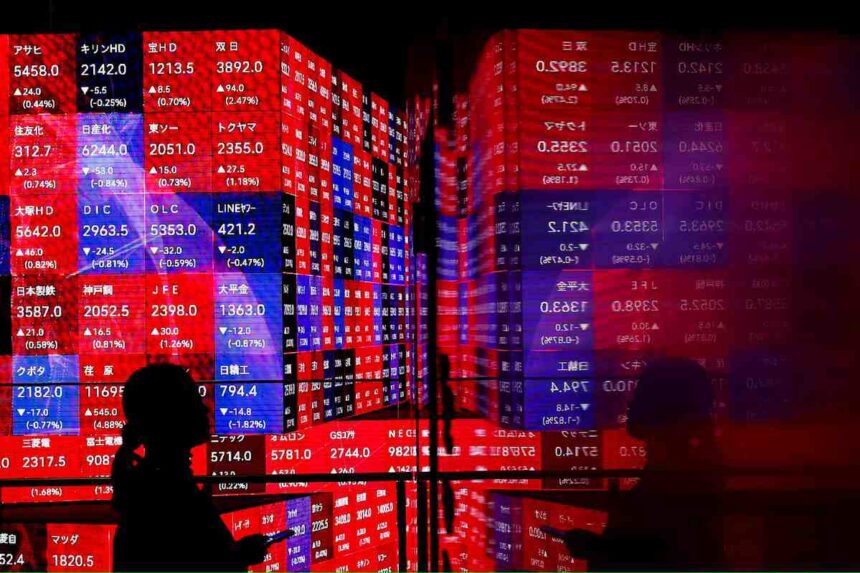
Asian equities advanced on Wednesday even as global investors continued to wrestle with uncertainty surrounding artificial intelligence valuations and long-term economic impact. Meanwhile, oil prices softened after diplomatic signals from U.S.-Iran nuclear talks reduced immediate fears of supply disruptions in the Middle East.
Japan led regional gains. The Nikkei 225 climbed 0.93% to 57,090.14, breaking a three-day losing streak. Australia’s S&P/ASX 200 added 0.5%. Several other key Asian markets including mainland China, Hong Kong, Singapore, Taiwan, and South Korea remained closed for Lunar New Year holidays, thinning regional trading volumes.
The cautious optimism in Asia followed a subdued session on Wall Street. The Dow Jones Industrial Average edged up 0.07% to 49,533.19. The S&P 500 rose 0.10% to 6,843.22 after initially sliding 0.88%, while the Nasdaq Composite gained 0.14% to 22,578.38.
Markets have been unsettled by questions over whether companies are overspending in the race to dominate AI infrastructure and applications. At the same time, investors are attempting to evaluate how the rapidly evolving technology may reshape labor markets and corporate earnings.
“AI uncertainty remains a source of volatility, both in terms of the difficulty in assessing which AI companies will be the winners and losers but also what sort of impact will AI have in other companies and sectors of the economy,” NAB analysts said.
Energy markets reflected a shift in geopolitical risk pricing. Brent crude traded at $67.42 per barrel and West Texas Intermediate at $62.32, after both benchmarks closed at more than two-week lows in the previous session.
Diplomatic developments in Geneva weighed on prices. Iran’s foreign minister said Tehran and Washington reached an understanding on main “guiding principles” towards resolving their longstanding nuclear dispute. The statement reduced immediate concerns about potential military escalation near the Strait of Hormuz — a critical artery for global oil supply.
In commodities, gold slipped 0.2% to around $4,867 per ounce, while silver declined by a similar margin to roughly $73.30 per ounce.
“Gold prices dipped as a stronger U.S. dollar weighed on the market, with declining U.S. Treasury yields providing little support,” ANZ analysts said.
“Investors remained uncertain amid subdued trading in Asia. Prospects of easing geopolitical tension with positive outcomes from the Iran-US talks in Geneva weighed on haven demand for gold.”
The U.S. dollar index was flat at 97.12 during Asian hours. The euro eased 0.1% to $1.1844, and sterling steadied at $1.3563 following earlier weakness.
The New Zealand dollar dropped 0.6% to $0.6014 after the country’s central bank signaled monetary policy would remain accommodative for an extended period to support economic recovery. The Australian dollar slipped 0.2% to $0.7075. Japan’s yen strengthened 0.1% to 153.12 per dollar.
Bond markets were largely stable. The benchmark U.S. 10-year Treasury yield held at 4.054%, while the 30-year yield dipped slightly to 4.6788%. Investors are awaiting minutes from the Federal Reserve’s January meeting later Wednesday for clearer signals on the trajectory of interest rates.
Separately, Japan faces mounting fiscal pressure. A Reuters report cited finance ministry estimates suggesting annual bond issuance could surge 28% within three years due to higher debt-financing costs. The government may need to issue up to 38 trillion yen ($248.3 billion) in fiscal 2029, compared with 29.6 trillion yen projected for fiscal 2026, as expenditures continue to outpace tax revenues.