
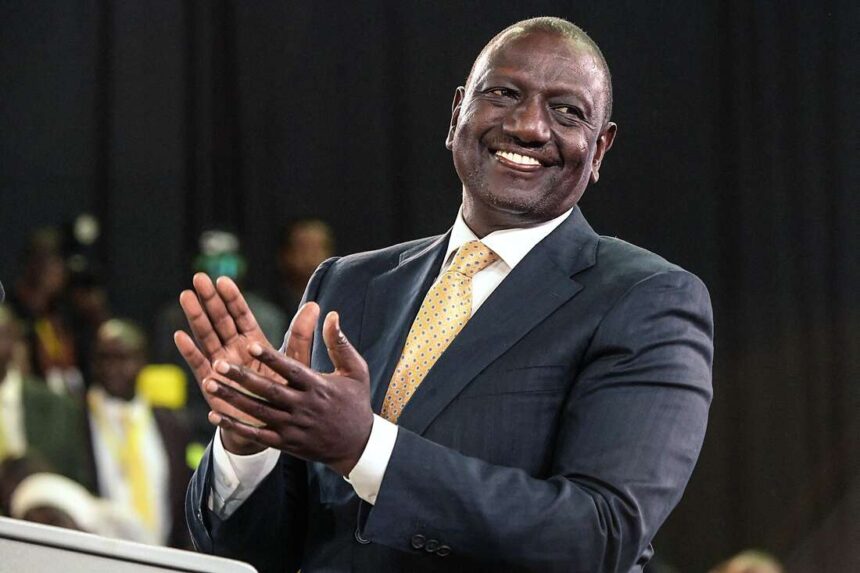
Kenyan President William Ruto is facing criticism after remarks about Nigerian-accented English triggered outrage across Africa and beyond. His comments, delivered during a meeting with Kenyans in Italy, quickly spread online and ignited a wider debate about language, identity, and post-colonial attitudes.
Speaking to the diaspora audience, Ruto praised Kenya’s education system and its English standards. He then drew a comparison that many found offensive. “If you listen to a Nigerian speaking, you don’t know what they are saying – you need a translator,” he said, prompting laughter from parts of the crowd.
He doubled down on the claim moments later: “Our education is good. Our English is good. We speak some of the best English in the world. If you listen to a Nigerian speaking, you don’t know what they are saying. You need a translator even when they are speaking English.”
The reaction online was immediate and intense. Critics from across the continent accused Ruto of belittling a fellow African nation and reinforcing colonial-era thinking about language and intelligence.
Zimbabwean journalist Hopewell Chin’ono wrote: “English is a colonial language, not a measure of intelligence, capability, or national progress.”
Nigeria and Kenya both use English as an official language, a legacy of British colonial rule. Yet each country has developed its own distinct style of speaking. Nigeria’s version reflects the influence of more than 500 local languages, shaping its rhythm and tone. Kenya’s accents, on the other hand, draw from Bantu, Nilotic, and Cushitic linguistic roots.
For many observers, these differences represent cultural richness, not deficiency.
Former Nigerian senator Shehu Sani pushed back strongly on social media. “Ruto is mocking the English of the country with a Nobel Prize for literature winner.The Nation of Achebe and Chimamanda,” he posted, referencing literary icons Wole Soyinka, Chinua Achebe, and Chimamanda Ngozi Adichie.
Others argued the Kenyan president should focus on domestic concerns such as unemployment and the rising cost of living rather than making controversial statements abroad.
Still, not all reactions were negative. Some Kenyans defended Ruto, suggesting the comments were meant humorously and taken out of context. They argued that online criticism overlooked the informal tone of the event.
The controversy also reflects a broader pattern. Kenya and Nigeria often engage in spirited online exchanges, fueled by comparisons in culture, economics, and politics. These digital rivalries can swing between playful banter and sharp criticism.
Earlier in April, Nigerian President Bola Tinubu faced backlash from Kenyans after claiming Nigerians were better off economically than citizens in other African countries, including Kenya. While Ruto did not directly reference that statement, some believe his remarks may have been a response.
Nigeria remains Africa’s largest English-speaking population. Its version of the language often called Nigerian English has gained global recognition. Expressions like “next tomorrow” have even entered mainstream dictionaries, showing how the country’s linguistic influence continues to grow.