
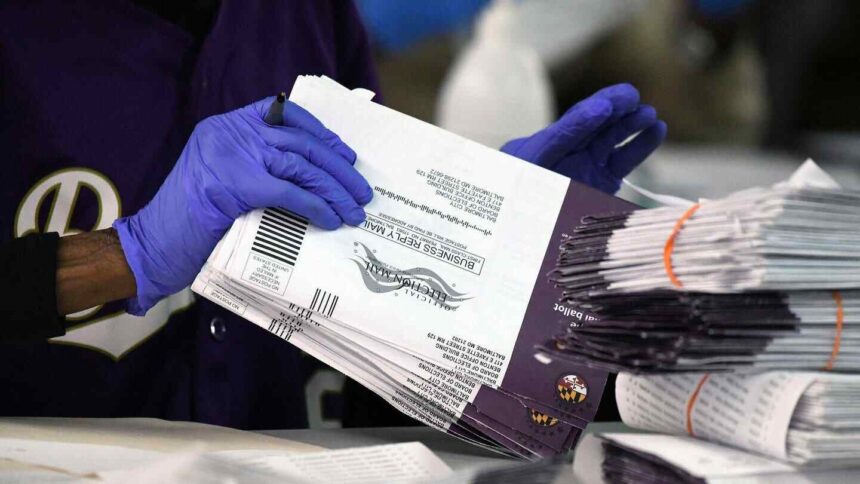
The Supreme Court ruled Monday that states can continue counting mailed ballots received after Election Day, provided they were postmarked by Election Day. The decision preserves election procedures used across much of the country and removes pressure on states to change voting rules before the 2026 congressional midterm elections.
In a 5-4 ruling, the court rejected a Republican-backed challenge to ballot receipt deadlines used in more than half of U.S. states and the District of Columbia. Many of those states allow election officials to count ballots that arrive days after voting ends, as long as voters mailed them on time. In just over half of those states, the extended deadlines apply only to military members and Americans living overseas.
Justice Amy Coney Barrett wrote the majority opinion, joined by Chief Justice John Roberts and the court’s three liberal justices. She said federal election laws establish a single Election Day but do not require states to receive every ballot before that day ends.
Federal laws setting a single Election Day “leave open when those votes must be received,” Barrett wrote.
She added that Congress, not the courts, should decide whether the country needs a uniform deadline for receiving mailed ballots.
“If varied deadlines for ballot receipt similarly call for a national solution, the American people must choose it through their elected representatives,” Barrett wrote.
The lawsuit grew out of President Donald Trump’s long-running criticism of mail voting. Trump has repeatedly argued that widespread mail balloting encourages fraud, despite years of election experience in many states and strong evidence rejecting that claim. He has also continued to argue that fraud affected his 2020 election loss to Joe Biden, even though more than 60 court decisions and his own attorney general found no basis for those claims.
Following Monday’s decision, Trump criticized the ruling on Truth Social and called on Congress to approve the SAVE America Act. The legislation has already passed the House of Representatives but has not advanced in the Senate.
“There is only one reason to oppose — CHEATING!” Trump wrote on Truth Social.
The Supreme Court heard oral arguments in March in a case involving Mississippi, Trump’s Republican administration, and the Republican and Libertarian parties. The central legal question was whether federal law requires mailed ballots to be both cast and received by Election Day.
Read Also: Tim Kaine Suggests Pete Hegseth’s Army Firings May Be Personal
Earlier, the federal appeals court in New Orleans invalidated a Mississippi law that allowed election officials to count ballots arriving within five business days after the election if they were postmarked by Election Day.
Election officials welcomed the Supreme Court’s decision, saying it avoids major disruptions ahead of the next federal election cycle.
The outcome is a “sigh of relief” for a lot of election administrators, said Stephen Richer, a Republican and the former top election administrator in Arizona’s Maricopa County, which includes Phoenix.
A ruling in favor of the Republican National Committee “would have created a whole host of administrative challenges for the affected states,” said Richer, who is now a legal fellow at the Cato Institute.
Read More: Supreme Court Rejects Trump’s Bid to Toss $5M E. Jean Carroll Sexual Abuse Verdict