

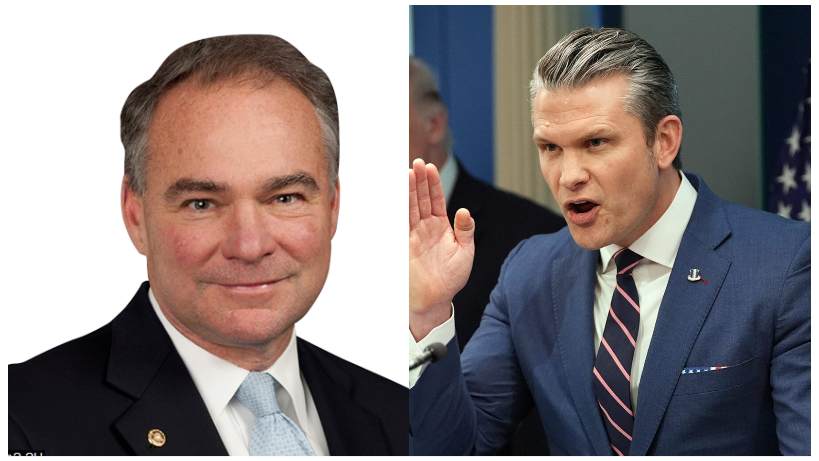
Fresh questions are emerging over recent leadership changes at the Pentagon after Sen. Tim Kaine (D-Va.) suggested Defense Secretary Pete Hegseth may be acting on a personal grievance rather than military priorities.
Speaking Sunday on CBS News’ Face the Nation, Kaine pointed to the retirement of Gen. Chris Donahue and a series of other departures involving senior Army officials. The Virginia senator questioned whether the Pentagon is removing experienced leaders in favor of officials who are less likely to challenge decisions.
“Are you pushing out the truth tellers to surround yourself by yes-men? And in particular, it looks like the secretary is coming down hardest … on the Army,” Kaine told host Margaret Brennan.
Kaine also raised concerns about Hegseth’s past experiences with the Army, arguing they could be influencing current personnel decisions.
“He served in the Army, he felt like he wasn’t treated well by the Army, that’s a grudge he’s carried that he’s described publicly. And so, when you see Army officers forced out, you got to wonder, is this a personal thing, or is it really what’s best for the nation?” the Virginia senator added.
The comments came days after Gen. Chris Donahue, commander of U.S. Army Europe and Africa, submitted retirement paperwork after serving just over one year in the position. According to a Pentagon official, Donahue will step down from command on July 2, a timeline later confirmed by the Army.
His departure adds to a growing list of senior military officers who have either been removed or left their positions during Hegseth’s tenure. Those leaders include former Joint Chiefs Chairman Gen. Charles Q. Brown Jr., Navy Chief of Naval Operations Adm. Lisa Frachetti, Coast Guard Commandant Adm. Linda Fagan, Army Chief of Staff Gen. Randy George, and Army Vice Chief of Staff Gen. James Mingus.
The latest leadership change has drawn concern from lawmakers in both parties.
Sen. Thom Tillis (R-N.C.), who has frequently criticized the Trump administration, argued that Donahue’s exit was unnecessary.
“Strong leaders are not threatened by accomplished commanders. Weak ones are. His paranoid micromanagement of senior military leaders and promotion lists is pure insecurity dressed up as reform,” Tillis wrote Thursday on social media, referring to the Defense secretary.
Others have urged caution until more information becomes available.
Rep. Clay Higgins (R-La.), a member of the House Armed Services Committee, said it would be premature to assume wrongdoing without knowing the full circumstances behind Donahue’s departure.
“I don’t automatically presume some improper decision was made by chain of command when somebody is let go and removed from a chain of command that was unexpected,” Higgins told The Hill on Thursday.
Kaine, who serves on the Senate Armed Services Committee, said lawmakers were surprised by Donahue’s retirement and have yet to receive a full explanation from Pentagon officials.
He said, “caught us all by surprise.” He also noted the committee does not “yet have good answers from the Pentagon” on the matter.
Congress has already begun considering stronger oversight of senior military dismissals. Earlier this month, the House Armed Services Committee approved a provision in the annual National Defense Authorization Act (NDAA) that would require the Pentagon to notify Congress in writing within five days whenever a senior military leader is fired or dismissed.
Kaine said senators could consider adding even stronger protections when the NDAA reaches the Senate floor later this year if lawmakers conclude additional oversight is needed.
“When we bring it up on the floor, I think by then, we’ll have some of our questions answered, and if we need to go [further] to put some guardrails in place, you’ll probably find bipartisan support to do that,” the Virginia Democrat told Brennan.
Read More: Senate Democrats Push $25 Minimum Wage Plan as Cost of Living Pressures Grow