
The Department of Government Efficiency (DOGE), the Trump administration office behind sweeping federal workforce reductions and spending cuts, officially ended its operations on July 4, marking the close of a key initiative launched at the start of President Donald Trump’s second term.
The agency announced its closure in a post on social media Saturday, sharing a quote from former President Teddy Roosevelt.
“‘Far and away the best prize that life offers is the chance to work hard at work worth doing.’”
DOGE followed the quote with a message reflecting on its work.
“While the formal mission of DOGE has come to an end, the mission to eliminate waste, fraud, and abuse will continue,” DOGE added. “Good stewardship of taxpayer dollars and accountable government are not temporary initiatives. We hope those principles endure long into America’s next 250 years.”
DOGE’s closure follows an executive order signed by President Trump on his first day back in office. The order transformed the U.S. Digital Service into the U.S. DOGE Service and instructed every federal agency to give the new organization full access to unclassified records, software platforms and information technology systems. The executive order also set the agency’s expiration date to coincide with America’s semiquincentennial.
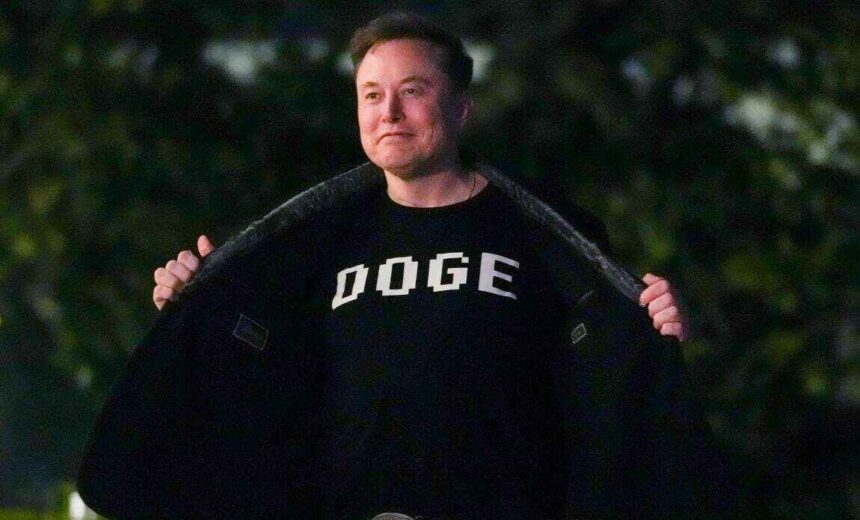
Although Amy Gleason served as DOGE’s acting administrator from February 2025 until the agency’s closure, Elon Musk became the public face of the department during its first months. Musk worked directly under President Trump as a special government employee for 130 days before leaving the administration.
After Musk’s departure, his relationship with Trump deteriorated over Musk’s criticism of the One Big Beautiful Bill Act, legislation that President Trump later signed into law in July 2025.
DOGE estimated that it generated about $214 billion in savings through contract cancellations, asset sales, workforce reductions, fraud prevention, regulatory changes, lease and grant terminations, interest savings and other cost-cutting measures. According to the agency, that equaled roughly $1,329 in savings for each of the nation’s approximately 161 million taxpayers and lowered the national debt by 0.54%.
Related: Trump ‘leaves instructions’ in case Iran assassinates him
The department’s work also sparked significant criticism. During Musk’s leadership, Tesla’s stock price fell sharply, and several people set Tesla vehicles on fire.
Critics also questioned whether DOGE’s cost-cutting efforts ultimately saved taxpayers money. In December, the environmental nonprofit Public Employees for Environmental Responsibility (PEER) estimated that the Trump administration’s deferred resignation program cost taxpayers about $10 billion during 2025.
PEER Executive Director Timothy White wrote to the U.S. Government Accountability Office, saying:
“Ironically, this unreasonably costly mass idling of civil servants was done in the name of ‘government efficiency,’”
Even as DOGE prepared to close, the administration requested $35 million from Congress for reimbursable program activity connected to the department during fiscal year 2027. The Hill reported that it requested comment from the White House regarding future cost-cutting efforts after DOGE’s shutdown.
White House spokesman Davis Ingle defended the administration’s record.
“has made significant progress in making the federal government more efficient to better serve the American taxpayer.”
The Office of Personnel Management reported that more than 272,000 federal employees left government service after President Trump returned to office. The reduction came through a hiring freeze, early retirement offers and workforce cuts.
Nearly 140,000 employees accepted the administration’s deferred resignation program, allowing them to continue receiving full pay and benefits until leaving federal service by Sept. 30, 2025.
The Departments of Defense, Treasury, Agriculture, Veterans Affairs and Interior recorded the largest number of departures. More than 48,000 Defense Department employees and over 23,000 Treasury Department employees left under the program.
Some of those workforce reductions were later reversed. Hundreds of employees who had been dismissed because of DOGE were rehired, while others kept their positions following court challenges.
DOGE also drew scrutiny during its early operations after seeking access to individual taxpayer information from the Internal Revenue Service, prompting concerns about privacy and the handling of sensitive financial records.
Several high-profile DOGE officials, including Musk, advisers Steve Davis and Katie Miller, along with general counsel James Burnham, left government service in May 2025. Even so, many former DOGE staff members remain in senior administration roles.
Gavin Kilger now serves as chief data officer at the Pentagon, while Sam Corcos is chief information officer at the Treasury Department.
Edward Coristine, the programmer known as “Big Balls,” continues working at the National Design Studio after surviving an attempted carjacking in Washington, D.C., last August.
Joe Gebbia, another former DOGE figure, now leads the National Design Studio, an initiative President Trump directed to improve federal government websites.
Read More: Appeals Court Again Rejects Trump Bid to Restore His Name to Kennedy Center