
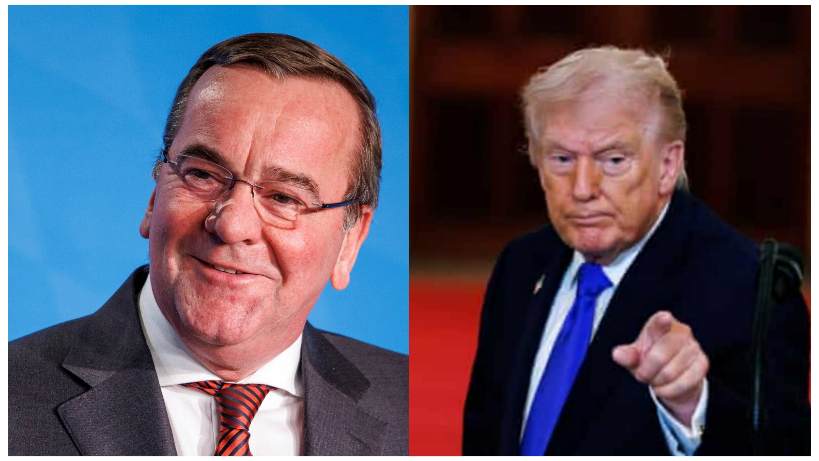
Germany has firmly rejected a request from Donald Trump to deploy naval forces to help reopen the Strait of Hormuz, with Berlin making clear it does not see the escalating crisis with Iran as its fight.
Speaking in Berlin on Monday, German Defense Minister Boris Pistorius pushed back strongly against the proposal, questioning the practicality and purpose of sending European warships into the region.
“What does . . . Donald Trump expect a handful or two handfuls of European frigates to do in the Strait of Hormuz that the powerful U.S. Navy cannot do?” Boris Pistorius said in Berlin, as reported by Reuters. “This is not our war, we have not started it.”
The comments came after Trump urged allies — particularly members of NATO — to help secure the crucial maritime corridor. The waterway, located between Iran and Oman, is responsible for transporting roughly 20 percent of the world’s oil supply, making it one of the most important shipping lanes on the planet.
According to shipping data from hormuzstraitmonitor.com, no vessels passed through the strait in the last 24 hours, a dramatic slowdown compared with the typical average of about 60 ships per day.
The disruption follows heightened tensions tied to the ongoing U.S.-Israeli war on Tehran, during which Iran has reportedly deployed missiles, drones, and naval mines to target oil tankers attempting to pass through the narrow corridor.
The closure has raised alarms across global energy markets, with analysts warning that prolonged disruption could trigger significant oil price volatility and global supply chain pressure.
Trump said he is currently in discussions with “about seven” countries about forming a coalition to help secure the shipping route.
A day earlier, the U.S. president posted on the social media platform Truth Social, suggesting several major economies should participate in maritime patrols.
China, France, Japan, the United Kingdom and South Korea were among the nations he cited as countries that should contribute naval assets because they benefit from the trade route.
In remarks to the Financial Times, Trump also warned that NATO’s long-term stability could be threatened if allies decline to assist.
“It’s only appropriate that people who are the beneficiaries of the strait will help to make sure that nothing bad happens there,” Trump said.
Despite the pressure from Washington, officials in Berlin signaled they have little appetite for direct military involvement.
German Foreign Minister Johann Wadephul told ARD that he was “very skeptical” about the effectiveness of deploying German naval vessels to the region.
Meanwhile, government spokesperson Stefan Kornelius emphasized that the conflict was not coordinated with European partners and should not be treated as a NATO operation.
“Neither the United States nor Israel consulted us before the war, and . . . Washington explicitly stated at the outset of the war that European assistance was neither necessary nor desired,” the he said.
Although Trump warned that NATO could face a “very bad” future if allies refuse to help protect the strait, Germany’s defense chief played down the possibility of a major rift inside the alliance.
Pistorius told reporters he does not expect the disagreement to fracture NATO, even as allies weigh their responses to the rapidly evolving Middle East crisis.
For now, European governments appear cautious about sending forces into a volatile region where military escalation could have far-reaching geopolitical and economic consequences.
Read More: Trump Administration Offers $10M Reward for Iranian Leaders Information