
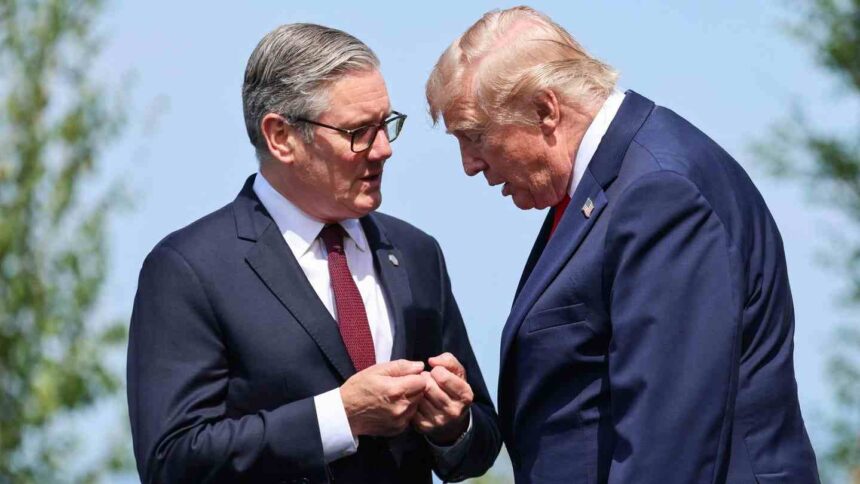
President Donald Trump intensified speculation surrounding British Prime Minister Keir Starmer’s future on Sunday, declaring that the UK leader is headed for the political exit door as questions continue to swirl around his leadership.
In a social media post, Trump stated: “Keir Starmer will resign as Prime Minister of The United Kingdom. He failed badly on two very important subjects- IMMIGRATION AND ENERGY (OPEN NORTH SEA OIL!). I wish him well!”
The remarks came as reports emerged suggesting Starmer could soon outline plans for his departure. According to the BBC, several individuals with connections to the British government believe the prime minister may reveal a timetable for stepping down as early as Monday.
The growing speculation marks a significant moment for Starmer, whose leadership has faced increasing scrutiny in recent months. While he has publicly committed to remaining in office, pressure has continued to build within the governing Labour Party.
Political uncertainty has been fueled by reports that fellow Labour figure Andy Burnham could emerge as a challenger. At the same time, some members of the party have privately and publicly signaled that Starmer should consider leaving the role, according to reporting cited by The Associated Press.
Economic concerns have also weighed heavily on the prime minister’s standing. Public dissatisfaction linked to ongoing financial challenges has contributed to a decline in his popularity, adding to broader questions about the government’s direction.
Starmer has faced criticism on another front as well. His decision to appoint Peter Mandelson as the United Kingdom’s ambassador to the United States drew scrutiny because of Mandelson’s connections to convicted sex offender Jeffrey Epstein.
If Starmer does leave office, he would become the sixth British prime minister to depart the position within the past decade, underscoring a period of exceptional political turnover in the United Kingdom.
Trump and Starmer have frequently disagreed on major international issues. Their differences have included debates surrounding NATO, as well as approaches to the conflicts in Ukraine and Iran.
Despite those disagreements, both leaders were present at last week’s Group of Seven (G7) summit in France. Discussions at the gathering were dominated by the newly announced peace agreement between Iran and the United States, a development that attracted significant international attention.
Read This: Keir Starmer Resigns as UK Prime Minister After Mounting Labour Revolt