
President Donald Trump’s administration has sharply criticized the Smithsonian Institution’s leadership, arguing that the nation’s largest museum complex has shifted away from objective history and toward political activism. The accusation comes as the White House signals it could seek major leadership and policy changes within the organization.
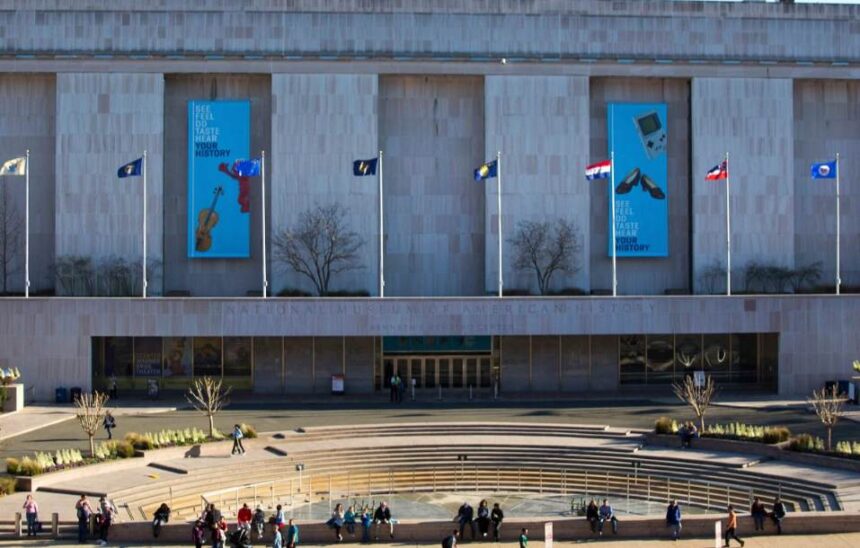
A report released by the White House Domestic Policy Council late on Independence Day claims the Smithsonian, especially the National Museum of American History, no longer presents America’s past in a balanced way. The document is the latest step in Trump’s broader effort to reshape federal cultural institutions and historical narratives.
“The Smithsonian Institution, and the National Museum of American History in particular, under its current leadership and current interpretive ideology, cannot be trusted to tell America’s story honestly and in a way that is inspiring, unifying, and worthy of our great republic,” the report states.
The council argues that museum officials have replaced traditional historical scholarship with political advocacy.
“As this report shows, confirmed in the words of Museum leadership, this ideological capture has moved the Museum’s mission away from straightforward historical education and scholarship toward an extreme political activism that seeks to transform our country.”
The report follows an executive order Trump signed in March directing federal agencies to eliminate funding for programs that promote what the administration described as “divisive narratives” and “improper ideology.” The order, titled “Restoring Truth and Sanity to American History,” specifically targeted changes at the Smithsonian Institution.
The White House Domestic Policy Council, led by a former senior Trump speechwriter, concluded that the National Museum of American History presents exhibits designed to weaken public confidence in American institutions.
“The National Museum of American History confronts visitors with materials intended to undermine faith in American institutions and the longstanding shared ideals of the American people,” the report says. “We must be committed to restoring truth and sanity in how American history is presented and taught.”
The report ends with another strong criticism, stating that the museum “by the intention and at the direction of current Museum and Smithsonian leadership, has become subject to institutional capture by a radical, activist ideology that is fundamentally opposed to telling the noble, honest story of the great country we know and love.”
The Smithsonian did not immediately respond to requests for comment on Sunday.
The institution is led by historian Lonnie Bunch, the first African American to serve as Smithsonian secretary. In an unrelated interview broadcast Sunday on NBC’s Meet the Press, Bunch discussed his philosophy on presenting American history.
“The notion of being a more perfect union, not the perfect union, is really what motivates me.”
He continued, “I think what I want people to understand is that there is a responsibility to continue to make those aspirations available, accessible, meaningful to a whole range of people.”
Bunch also said, “And that, in essence, America’s greatest strength, it’s not running away from its history, but it’s understanding how that history shaped us and continues to shape us.”
The National Museum of American History is directed by historian Anthea M. Hartig, the first woman to hold that position.
The administration’s criticism of the Smithsonian fits into a larger campaign to reshape major cultural and educational institutions. Earlier this year, Trump became chairman of the John F. Kennedy Center for the Performing Arts as part of an effort to change its programming. A board selected by Trump later voted to place his name on the building before a federal judge ordered the signage removed.
The administration also pressured Columbia University to adopt policy changes after threatening to withhold hundreds of millions of dollars in federal funding.
Outside Washington, the administration has pursued changes at historical sites as well. In Philadelphia, a federal court recently allowed officials to reinstall interpretive panels at the site of President George Washington’s home. Critics argue the revised displays minimize the history of slavery in favor of a more celebratory account of the nation’s past.
Pennsylvania Gov. Josh Shapiro criticized those efforts during an interview Sunday on CNN’s State of the Union.
“There’s not one individual narrative that a president gets about our history,” Shapiro said. “And any president should want to make sure that that full history is shared, that the American people are able to draw their own conclusions.”
He added, “If we understand where we came from, we’re going to have a better path forward.”
The White House report and Trump’s executive actions suggest the administration intends to continue pressing for changes at museums and other public institutions as part of its effort to redefine how American history is presented to the public.